Bite-Sized Betrayal: How the Mall Food Court Perfected the Free Sample Trap
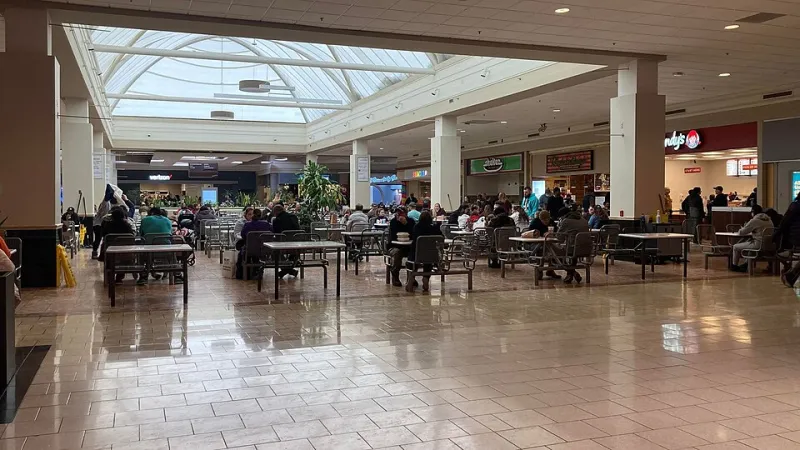
Photo: Lallint, CC0, via Wikimedia Commons
There's a moment — you know the one. You're walking past the pretzel kiosk, minding your own business, when a teenager in a visor extends a tiny paper cup toward you and says the single most dangerous word in American retail: "Free?"
You didn't want a pretzel. Two seconds ago, you didn't know you weren't in the market for a pretzel. And yet here you are, three minutes later, at the register, handing over $8.49 for a cinnamon twist the size of your forearm, wondering what just happened.
What happened is the oldest con in the mall playbook, and we've been falling for it since the Reagan administration. So Sugar Rush did what we do best: we grabbed a lanyard, squinted suspiciously at kiosks, and got to the bottom of the free sample industrial complex.
The Toothpick Heard Round the Food Court
The free sample wasn't born in a mall. Grocery stores and county fairs had been slipping people cheese cubes for decades. But the mall food court — that fluorescent liminal space between the pet store and the pretzel place — perfected it. High foot traffic, captive audiences, and zero chance of escape: the kiosk corridor is basically a willpower wind tunnel.
"You're not selling food," one former sample-slinger told us, on the condition we change her name because she still works in retail. "You're selling momentum. The second someone stops walking and chews, the sale is basically over. I could tell you who was buying before they finished swallowing."
She's not wrong. Industry folks have known for ages that sampling can multiply conversion rates — some retail studies have shown sampled shoppers are dramatically more likely to buy than browsers. The mall just took that math and added cinnamon frosting.
The Big Three: A Taxonomy of Temptation
After extensive fieldwork (someone had to eat the samples), we've classified the food court's sampling strategies into three distinct schools:
The Cinnabon Gambit. The strategic bite. A single, warm, surgically placed morsel delivered at the exact moment the scent cloud hits maximum density. The smell does the marketing; the sample just closes. This is the heavy artillery of the sampling world.
The Smoothie Cup Pyramid. A tray of thimble-sized cups arranged like a tiny edible skyline. Low cost per unit, high foot-traffic conversion. You take one "because it's rude not to," and suddenly you're explaining to your kid why you're now the proud owner of a large mango-berry blast with a souvenir cup.
The Long-Game Cookie Push. No tray, no pressure — just a warm cookie pressed into your hand at the entrance to the store. By the time you've finished it, you've browsed the whole display and emotionally bonded with a tin of shortbread you'll gift to someone you only mildly like.
Confessions From the Other Side of the Counter
We spoke with three former sample-slingers, and the tactics they described were somewhere between marketing science and psychological warfare:
- Never say "sample." Say "free." "Sample" implies obligation. "Free" implies a gift, and humans are wired to reciprocate gifts. Yes, even toothpick-sized gifts.
- Eye contact is optional. Offering to a group is not. Hand samples to the kids first. Parents will buy anything to end a negotiation they're losing.
- The tray retreat. If you hesitate, they start pulling the tray away. Nothing activates the scarcity instinct like a disappearing brownie cube.
- Timing is everything. Peak sample hours are 11 a.m. to 1 p.m. and the after-school window, when blood sugar is low and resistance is lower.
One interviewee summed it up beautifully: "We weren't feeding people. We were interrupting them. Nobody walks into a mall hungry for a smoothie. We made them hungry, then we made them ours."
The Field Guide: Escaping the Kiosk With Your Wallet Intact
Look, we're a dessert site. We're not anti-treat — we've ranked milkshakes by sugar rush potential and once drove 500 miles for state fair funnel cake. But there's a difference between choosing dessert and being chosen by dessert. For the record, our field-tested escape protocols:
The Gracious No. Smile, wave politely, keep walking at a steady pace. The kiosk operator respects this. It's the hesitation that gets you.
The Full-Mouth Defense. If you're already eating something (churro, soft pretzel, your child's leftover fries), simply gesture at your mouth. Nobody pushes a sample on someone mid-chew. It's kiosk law.
The Budget Pre-Commit. Decide before you enter the food court what you're buying, if anything. This works about 60% of the time, which frankly is a better track record than most of our New Year's resolutions.
The Counter-Move. Take the sample, enjoy it, and then don't buy anything — because sometimes you try a bite of something and realize it's not your thing, and that's a win too. The sample economy runs on guilt; starve it.
In Defense of the Sample (Yes, Really)
Here's our official Sugar Rush position: the free sample, when wielded honestly, is actually one of the great democratic institutions of American snacking. It's a no-strings-attached taste before you commit your allowance, your lunch money, or your discretionary fun budget. It lets a kid try a mango smoothie before begging for a large. It lets you discover that the new pretzel flavor is, in fact, life-changing.
The problem isn't the bite. The problem is the trap — the guilt architecture built around a two-cent cube of cookie dough.
So the next time a visor-wearing teen extends a tiny cup your way, take a breath. Take the sample if you want it. Then make the decision the old-fashioned way: with your taste buds, your budget, and your dignity fully intact.
And if you walk away with the cinnamon twist anyway? Hey. We're not here to judge. Some battles aren't worth fighting — some battles come with frosting.


